Introduction
In trampoline parks and inflatable amusement environments, one of the most common injury mechanisms involves a patron making forceful contact with a rigid surface—whether that be the ground, structural components, or surrounding equipment. The evaluation of these incidents frequently centers on whether appropriate protective materials were present to reduce the severity of impact.
This article provides a practical explanation of impact attenuation as it applies to trampoline courts and inflatable devices, including the governing principles, applicable standards, and accepted testing methodologies used to assess compliance.
Fundamental Concept of Impact Attenuation
Impact attenuation refers to the ability of a material or system to reduce the forces experienced during a collision. From a physics standpoint, force is the product of mass and acceleration. When a person lands on a surface, the goal is to reduce peak acceleration by extending the duration and distance over which deceleration occurs.
In practical terms, this means that properly designed padding or surfacing systems absorb and dissipate energy, rather than allowing it to be transferred directly back into the body. When effective, these systems reduce the likelihood and severity of injuries such as fractures, joint damage, and head trauma.
Protective surfacing is widely used across multiple activities, including playgrounds, gymnastics facilities, and athletic fields. While the purpose is consistent—reducing injury risk—the required performance criteria and testing methods vary depending on the application and governing standards.
Application in Amusement Devices
In amusement environments, impact-attenuating materials are typically installed over rigid or structural components that a patron may contact during normal or foreseeable use. These materials commonly consist of foam cores encased in durable coverings designed to withstand wear, moisture, and environmental exposure.
The placement of these materials is not arbitrary. Instead, it is dictated by hazard identification—specifically, identifying locations where a patron could reasonably experience an uncontrolled or unintended impact.
Relevant ASTM Standards
Two primary ASTM standards govern the use of impact attenuation in trampoline and inflatable amusement devices:
Inflatable Devices – ASTM F2374
Inflatable amusement devices rely on air pressure to maintain their structure and are commonly used for bouncing or interactive play activities. Under ASTM F2374:
- Areas where patrons enter and exit the device must be protected.
- These locations require impact-attenuating mats that meet specified performance criteria.
- The purpose is to mitigate the risk of injury when a patron transitions between elevated inflatable surfaces and adjacent ground areas.
Trampoline Courts – ASTM F2970
Trampoline court systems consist of interconnected trampoline beds and surrounding structures. Under ASTM F2970:
- All rigid components within the device-use zone must be appropriately padded.
- This includes frames, springs, structural supports, and adjacent assembly areas.
- The requirement extends to any location where a user could reasonably make contact during use.
Both standards rely on a common testing methodology to verify compliance with performance requirements.
Impact Testing Methodology (ASTM F355)
The performance of impact-attenuating materials in these environments is evaluated using ASTM F355, which measures the ability of a surface to reduce impact forces.
Testing involves controlled impacts using specialized instrumentation designed to simulate human contact with a surface. The primary metric obtained from this testing is the peak deceleration value, commonly expressed as Gmax. Lower Gmax values indicate better energy absorption and reduced injury potential.
Field and laboratory testing must be conducted using calibrated equipment and repeatable procedures to ensure reliable results. Consistency in testing conditions—such as drop height and impact mass—is critical for meaningful comparisons and compliance verification.
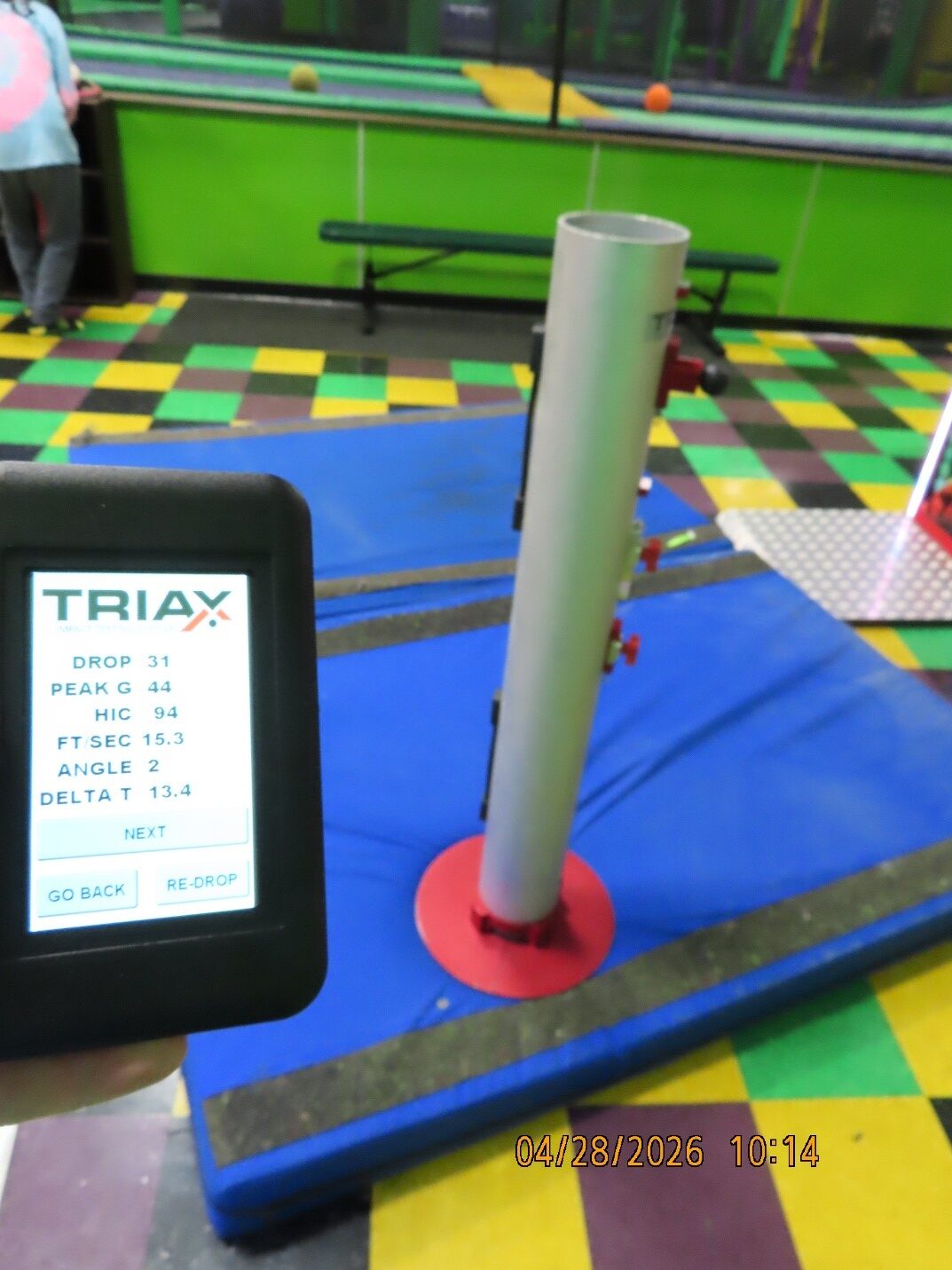
As shown in the testing setup depicted in this article, devices such as instrumented impact missiles are used to generate consistent and measurable impacts across multiple test locations.
Role in Forensic Investigations
In the context of incident analysis, impact attenuation is a key factor in determining whether an amusement device met the applicable standard of care. This evaluation typically includes:
- Identifying all potential impact points within the device-use area
- Determining whether protective materials were present where required
- Verifying whether those materials met ASTM F355 performance criteria
- Assessing whether degradation, improper installation, or maintenance deficiencies affected performance
Deficiencies in any of these areas may contribute to increased injury risk and are often central to liability evaluations.
Conclusion
Impact attenuation is a fundamental safety component in trampoline and inflatable amusement devices. Its purpose is not merely to provide comfort, but to actively reduce the forces transmitted to the body during an impact event.
Compliance with ASTM standards requires both proper placement of protective materials and verification of their performance through recognized testing methods. When these elements are absent or inadequate, the risk of injury increases significantly.
A thorough understanding of these principles is essential for both operational safety and forensic evaluation of amusement-related incidents.
Contact Miller Safety Inspections & Consulting, Inc. for a case evaluation regarding performing ASTM 355 drop testing.