Inflatable amusement devices have become one of the most common attractions at fairs, festivals, school events, churches, and rental venues across the country. Their portability, low cost, and broad appeal make them a popular choice for family entertainment.
But the same characteristics that make inflatables convenient also make them uniquely vulnerable to one of the most foreseeable environmental hazards in the amusement industry: wind.
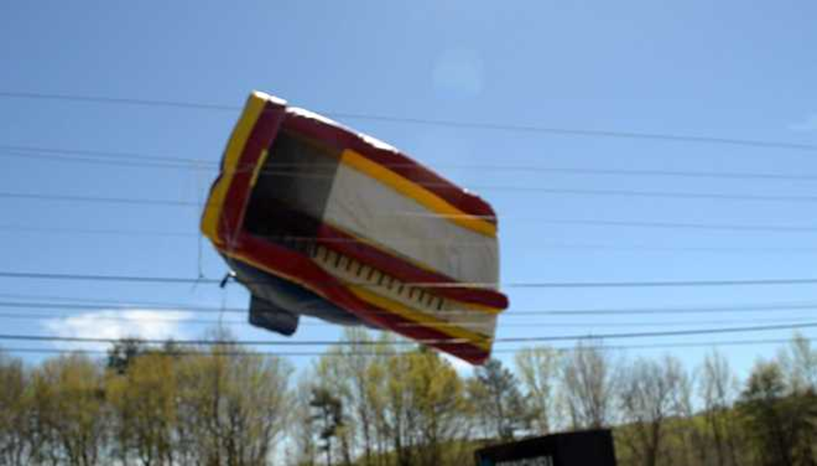
Unlike fixed mechanical rides, inflatables rely on air pressure, flexible fabric structures, and anchoring systems to remain stable. When wind loads increase—or when anchoring systems are improperly installed—these devices can shift, overturn, collapse, or in extreme cases become airborne. Wind-related incidents are not rare anomalies. They represent one of the most widely recognized and preventable causes of serious inflatable accidents.
The Consumer Product Safety Commission (CPSC) has tracked inflatable amusement incidents for decades. Between 2003 and 2013, the Commission documented thousands of injuries and fatalities and estimated more than 113,000 emergency-department treated injuries nationwide. The CPSC concluded that the majority of these incidents were attributable not to hidden defects, but to improper setup, supervision, and operation.
The primary consensus standard governing commercial inflatable amusement devices in the United States is ASTM F2374-24, which establishes requirements for design, manufacture, installation, operation, maintenance, inspection, and training. ASTM makes clear that inflatable stability is not a matter of operator discretion or event-day judgment. Wind forces must be considered both in engineering design and in daily field operations.
Most wind-related inflatable failures begin with anchoring deficiencies. ASTM requires inflatable devices to be provided with anchoring systems capable of preventing unplanned displacement under patron loading and environmental wind forces. Devices must include a sufficient number of anchor points, with a minimum of four, and anchoring must be fixed, stationary, and installed according to design specifications.
One of the most common failures in inflatable operations is the absence of clear wind thresholds. ASTM requires that inflatables not be operated when sustained wind speeds exceed the maximum wind speed specified by the manufacturer. If the manufacturer has not provided an operational wind limit, ASTM requires the owner/operator to adopt 15 mph as the default maximum, or obtain an engineering analysis establishing an alternate limit.
Wind safety depends on preparation, documentation, training, and decision-making before conditions become critical. Owner/operators must embed wind safety into written operating procedures, including weather monitoring, shutdown thresholds, evacuation plans, and staff training.
ASTM requires every inflatable amusement device to have an evacuation plan maintained by the owner/operator. The most dangerous operational mistake is waiting until instability occurs. The recognized standard of care requires shutdown and evacuation before unsafe wind conditions develop—not after.
Wind is one of the most recognized external hazards affecting inflatable amusement devices. The standard of care requires engineered anchoring systems, defined wind limits, continuous monitoring, and immediate evacuation and deflation when limits are approached. When these measures are followed, wind-related inflatable incidents are largely preventable. Wind safety is not simply best practice—it is the foundation of responsible inflatable amusement operation.
Contact Information:
Lance Miller
Miller Safety Inspections & Consulting, Inc.
Lmiller@amusementinjuryexperts.com
www.trampolineparkinspections.com
719-440-5846